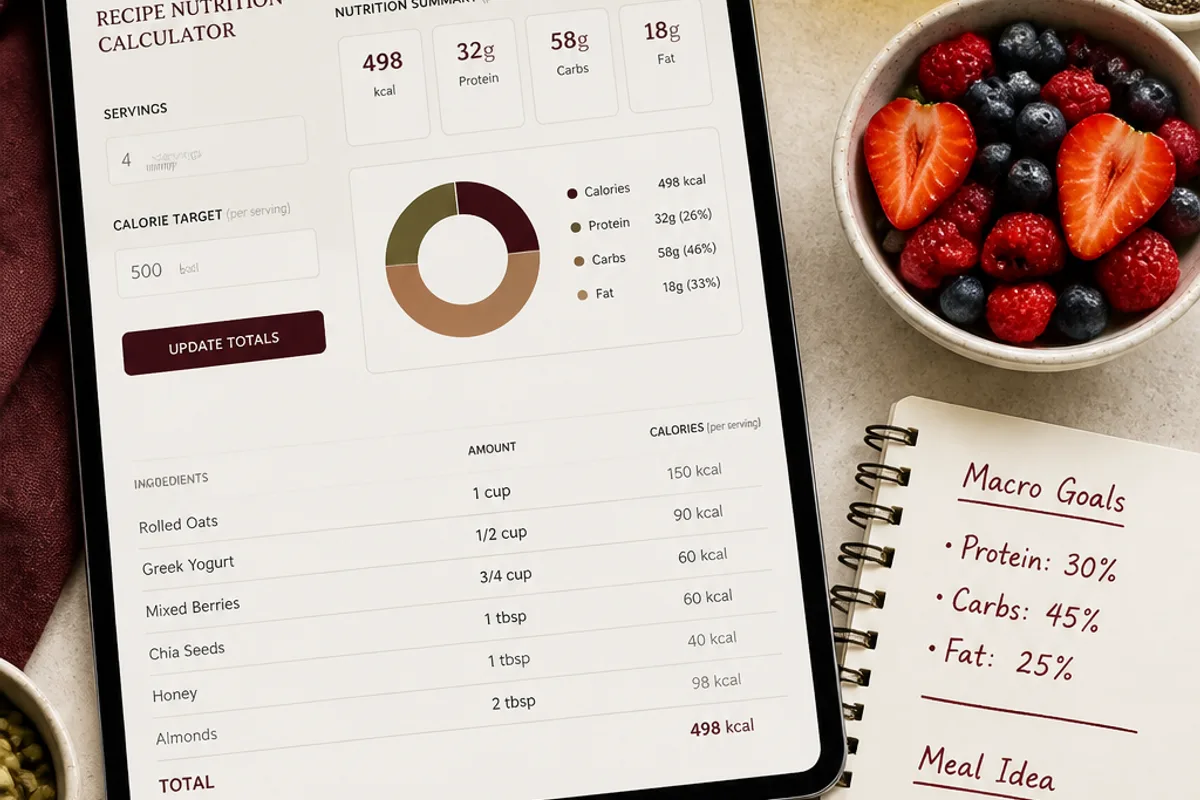
Quick takeaways
- ✓ Enter ingredients in plain measurable units: grams, ounces, cups, tablespoons, or whole items.
- ✓ Set the recipe yield before comparing calories or macros per serving.
- ✓ Check oils, nuts, dairy, sweeteners, and grains first because small measurement errors change totals quickly.
- ✓ Match the entry to the ingredient: raw weight with raw entries, cooked weight with cooked entries.
Start with a clean ingredient list
Nutrition calculators work best when every line contains one ingredient, one quantity, and one unit. Instead of pasting a full instruction like “saute one large onion in a generous drizzle of olive oil,” split it into “1 large onion” and “1 tablespoon olive oil.” That small cleanup step makes the final estimate much more useful.
If a recipe uses vague words like handful, splash, knob, or drizzle, translate them into a practical kitchen estimate. A splash of milk might be one tablespoon, a drizzle of oil might be one or two teaspoons, and a handful of nuts might be about 28 grams. The goal is not laboratory precision; it is consistent recipe planning.
- Use grams for flour, oats, rice, pasta, nuts, and cheese when possible.
- Use tablespoons or teaspoons for oils, sauces, syrups, and nut butters.
- Keep brand-specific packaged foods separate if the nutrition label is important.
Set servings before judging the result
Most recipe nutrition mistakes happen after the total is calculated. A pot of soup may look high in calories until it is divided into eight bowls. A loaf cake may look moderate until it is cut into ten slices instead of sixteen. Decide the realistic number of portions first, then compare per-serving nutrition.
For meal prep, use the container count as the serving count. If a casserole fills six containers, the serving count is six. If you plan to eat half portions with a salad or side, create a note rather than forcing the calculator to guess.
Serving math is the bridge between recipe data and real meal planning. Always calculate both total recipe nutrition and per-serving nutrition before changing ingredients.PairDish Tool Scale the recipe before calculating Resize recipes first so your nutrition estimate matches the batch you actually cook.
Find the ingredients that move the numbers most
When the result looks surprising, audit the high-impact ingredients first. Oil, butter, cheese, cream, nuts, seeds, flour, pasta, rice, sugar, and dried fruit can change a recipe by hundreds of calories if the measurement is off. Vegetables, herbs, broth, vinegar, and spices usually have a smaller impact.
This is especially helpful when you are trying to adjust a recipe. Reducing one tablespoon of oil can matter more than removing an entire cup of spinach. Adding a cup of beans may increase calories but also improves fiber and protein. Look at the whole macro picture rather than calories alone.
- Want fewer calories? Check oil, butter, cheese, nuts, and sugar first.
- Want more protein? Add beans, lentils, Greek yogurt, tofu, eggs, fish, poultry, or lean meat where appropriate.
- Want more fiber? Add legumes, vegetables, whole grains, berries, or seeds.
What the Nutrition Facts label actually measures
A recipe calculator is doing the same job as a Nutrition Facts panel: describing a defined serving of a defined food. The FDA is explicit that a label serving size “reflects the amount that people typically eat or drink” and that it “is not a recommendation of how much you should eat or drink.” That one sentence explains most serving-size arguments.
It also explains why every number moves together. On the FDA sample label for frozen lasagna, one cup is 280 calories; eat two cups and you have taken in 560 calories, and every other nutrient and percentage doubles with it. A recipe calculator behaves the same way — change the yield and every per-serving figure changes — which is why setting servings first is part of the measurement, not bookkeeping.
Labels also standardize the unit: a familiar household measure first, the metric weight second. That is the format worth copying into your own recipes. “One scoop” does not travel between tools; “45 g” does.
- The %DV column does not add up to 100% down the side of a label; each line is that nutrient’s share of its own daily value.
- Protein, total sugars, and trans fat normally carry no %DV — a protein %DV appears only when the label makes a protein claim.
- FDA’s reading rule: 5% DV or less of a nutrient per serving is low, 20% DV or more is high.
| Nutrient | Daily Value | Goal |
|---|---|---|
| Saturated fat | 20 g | Less than |
| Sodium | 2,300 mg | Less than |
| Added sugars | 50 g | Less than |
| Dietary fiber | 28 g | At least |
| Vitamin D | 20 mcg | At least |
| Calcium | 1,300 mg | At least |
| Iron | 18 mg | At least |
| Potassium | 4,700 mg | At least |
The fastest sanity check on any recipe estimate is to ask what share of a day’s sodium, added sugar, or protein one serving carries. That question catches more errors than recalculating every ingredient.PairDish Tool Match a recipe to a dietary pattern Filter meal ideas when sodium, added sugar, or protein targets are the deciding factor.
Added sugars versus total sugars: the label line that fools recipe math
Total sugars counts everything: sugars naturally present in milk, fruit, and vegetables plus anything added during processing or cooking. Added sugars counts only the sweeteners — sucrose, dextrose, syrups, honey, and concentrated fruit or vegetable juices. On the FDA example, a yogurt label reading “Total Sugars 15 g, Includes 7 g Added Sugars” means 7 g were added and 8 g occur naturally in the yogurt itself.
For recipe math that distinction matters. A fruit-sweetened smoothie, a yogurt marinade, and a honey-glazed sheet pan can land on the same total sugar number with very different added sugar totals. If added sugar is what you are watching, enter the sweetener as its own line — honey, maple syrup, brown sugar — rather than relying on a combined ingredient entry that hides it.
Percentages make the point faster than grams. Added sugars use 50 g per day as their 100% Daily Value, so a recipe contributing 12 g of added sugar per serving is already at 24% DV. By FDA’s own reading rule, that is a high-sugar serving.
- Enter sweeteners separately: they are the only added-sugar source most home recipes contain.
- Natural sugars from milk, fruit, and vegetables still count toward total sugars, so a smoothie can read high while carrying no added sugar at all.
- When a packaged ingredient is doing heavy lifting in a recipe, use its label numbers rather than a generic database entry.
The raw-versus-cooked check that fixes most calculator errors
Ingredient databases carry separate entries for raw, cooked, drained, and ready-to-eat versions of the same food, and the gaps are large. USDA FoodData Central lists 22.5 g of protein per 100 g for raw boneless skinless chicken breast and 32.1 g per 100 g for the same cut cooked and braised. Nothing was added; water cooked off, so every gram of the cooked food now carries more protein.
That means the entry you pick has to match the food in front of you. A 200 g portion of cooked chicken read against a raw entry comes out near 45 g of protein; read against a cooked entry it is about 64 g. Choosing the wrong state moves the number by 30 to 40 percent without a single ingredient being wrong.
The same logic covers cans and packages. Drained solids, solids and liquids, and rinsed items are different entries, and as-purchased weights include parts you do not eat. Select the entry that describes what actually lands on the plate.
- Type the weight in the same state as the entry: raw weight with raw entries, cooked weight with cooked entries.
- Batch cooking? Note the raw weight before the pan, because that is the number the database understands.
- When a recipe and a package label disagree, the label wins for that packaged product; the database entry wins for loose ingredients.
| Food and entry state | Protein per 100 g |
|---|---|
| Chicken breast, boneless, skinless — raw | 22.5 g |
| Chicken breast, meat only — cooked, braised | 32.1 g |
| Fish, tuna, light, canned in water — drained solids | 25.5 g |
| Egg, whole — cooked, hard-boiled | 12.6 g |
| Lentils, mature seeds — cooked, boiled | 9.02 g |
| Yogurt, Greek, plain, lowfat — ready to eat | 9.95 g |
Before trusting a total, write the raw weight next to what came off the pan. If the two are far apart, check that the entry matches the weight you typed.PairDish Tool Convert weights and volumes first Get grams, ounces, cups, and tablespoons onto one scale before comparing entries.
Use the result as an estimate, not medical advice
A recipe calculator is a planning tool. Ingredient databases, brand differences, cooking loss, drained liquids, and serving sizes all affect the final numbers. For general home cooking, a thoughtful estimate is usually enough to plan meals, compare recipes, and build grocery lists.
If you are managing a medical condition, allergy, eating disorder recovery, pregnancy nutrition, kidney disease, diabetes, or another specialized diet, use these numbers as a starting point and verify decisions with a qualified professional.
Use PairDish as a planning assistant
PairDish calculators are designed for home cooking estimates, meal planning, and recipe comparison. They are not a substitute for medical nutrition advice, allergy guidance, or a personalized diet plan from a qualified professional.
Keep planning your plate
Pairing decisions get easier with a framework. Browse the guides below for more combinations that work, or jump straight into a calculator to size the meal.
Sources & further reading
- FDA — How to Understand and Use the Nutrition Facts Label — Source of the serving-size definition, the 5%/20% %DV reading guide, the Daily Value table, and the added-sugars example cited above.
- USDA FoodData Central — Source of the protein values in the entry-state table (chicken breast raw FDC 2646170, cooked FDC 331960, and the other food-detail pages for each row).
- USDA National Agricultural Library — DRI Calculator — Estimates daily calorie and nutrient needs from the Dietary Reference Intakes.