Quick takeaways
- ✓ Set the weekly grocery number before choosing recipes.
- ✓ Use two or three low-cost base ingredients across multiple meals.
- ✓ Plan one flexible “use-it-up” dinner to prevent waste.
- ✓ Check official average prices before trusting any “deal”; the unit price settles arguments fast.
Start with the budget, not the recipes
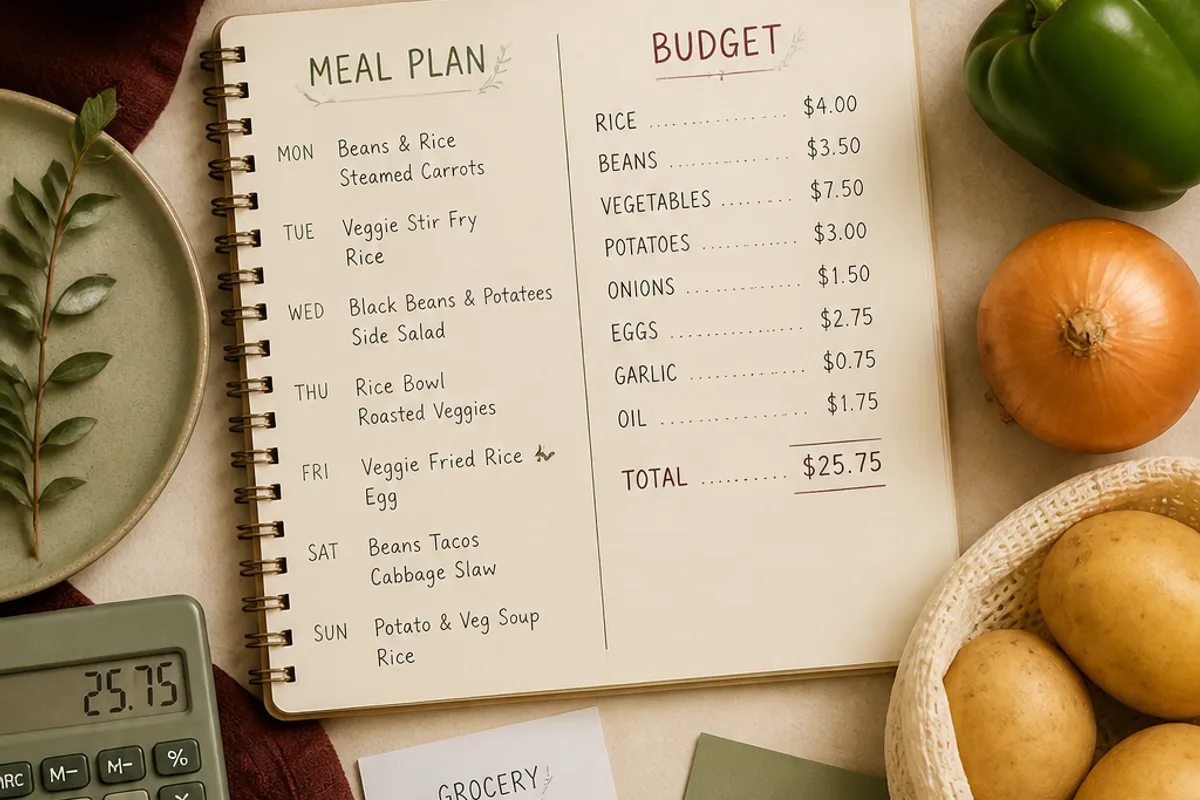
Most grocery plans fail because recipes are chosen first and the total is discovered at checkout. Reverse the process. Write your target grocery number for the week, subtract any fixed household items, then plan meals with the remaining food budget.
This does not mean eating the same thing every day. It means choosing recipes that share ingredients. A bag of rice can support bowls, fried rice, soup, and burritos. A carton of eggs can become breakfast, salad topping, quick dinner, or baking ingredient. Repetition at the ingredient level creates variety at the meal level.
- Budget first: choose the weekly food number before browsing recipes.
- Ingredient overlap: use the same ingredient in at least two meals.
- Waste check: plan where leftovers go before buying more.
What food prices are doing right now
Budget math works better when it starts from the official picture instead of a headline. The USDA Economic Research Service tracks food prices every month. In its September 2026 forecast, food-at-home prices were 2.2 percent higher in August 2026 than a year earlier, and the agency expects a 2.4 percent rise across the whole of 2026, with a forecast interval of 1.8 to 3.0 percent.
The category detail is where it gets useful for planning. Eggs sit 23.0 percent below their level a year earlier and are forecast to fall 29.4 percent across 2026, dairy is close to flat, and fats and oils are the other category forecast to decline. The increases are concentrated in beef and veal, fresh vegetables, and sweets. That tells you where substitutions pay off this year and where they do not:
| Category | Last 12 months | 2026 forecast |
|---|---|---|
| Food at home (all) | +2.2% | +2.4% |
| Beef and veal | +5.9% | +9.4% |
| Pork | +0.6% | +1.2% |
| Poultry | +0.5% | +1.0% |
| Eggs | -23.0% | -29.4% |
| Dairy products | -0.3% | +0.1% |
| Fresh fruits | +3.8% | +2.5% |
| Fresh vegetables | +2.6% | +5.7% |
| Sugar and sweets | +6.1% | +6.6% |
| Nonalcoholic beverages | +3.7% | +4.2% |
Planning rule for the year: lean on eggs, dairy, and cooking fats while they are flat or falling, and make beef and sweets the categories where substitutions earn their keep.
Pick price anchors for the week
Price anchors are ingredients that reliably stretch meals without taking over the whole plate. Rice, oats, potatoes, pasta, beans, lentils, cabbage, carrots, frozen vegetables, eggs, and seasonal produce are common examples. The best anchors depend on your store prices and cooking style.
Choose two or three anchors each week. Then build meals around them with different flavors. Rice can become a bean bowl, curry, soup, or skillet. Potatoes can become breakfast hash, sheet-pan dinner, soup, or loaded wedges. Beans can become tacos, salad, pasta sauce, or dip.
Know the street price of your staples
Price anchors only work when you know what they normally cost. Every month the Bureau of Labor Statistics publishes average U.S. city prices for common foods, which makes a free reality check for any deal you see. Here is what the basics averaged in September 2026:
| Staple | Average price |
|---|---|
| Eggs, grade A large (per dozen) | $2.27 |
| Milk, whole (per gallon) | $4.11 |
| Bread, white pan (per pound) | $1.83 |
| Chicken, whole (per pound) | $2.06 |
| Ground beef, 100% beef (per pound) | $6.79 |
| Spaghetti and macaroni (per pound) | $1.38 |
| Rice, white long grain, uncooked (per pound) | $1.12 |
| Beans, dried (per pound) | $1.67 |
| Potatoes, white (per pound) | $0.99 |
| Bananas (per pound) | $0.66 |
| Tomatoes, field grown (per pound) | $1.99 |
| Lettuce, iceberg (per pound) | $1.64 |
Notice the spread: whole chicken at $2.06 a pound and dried beans at $1.67 give you very different dinner math than ground beef at $6.79. A price only beats these averages when it lands meaningfully under them.
Use one grocery list for multiple meals
A budget grocery list should be organized by overlap. If you buy cilantro, use it for tacos, bowls, and soup topping. If you buy Greek yogurt, use it for breakfast, sauce, and a creamy dressing. If you buy cabbage, use it for slaw, stir-fry, soup, and bowls.
This is where budget planning becomes easier than strict coupon planning. You are not chasing every sale; you are making sure every item has a job. A smaller list with high-utility ingredients often beats a bigger list full of one-off items.
Before an item goes on the list, ask: “Which two meals will use this?” If the answer is only one, consider a substitute you already have.
Unit price: the one number that beats every coupon
The unit price, or cost per ounce, pound, quart, or gram, is the single most honest number in the store. Most shelf tags print it; when they do not, it takes ten seconds to figure out: divide the price by the size of the package.
A $6.49 jar holding 64 ounces comes to about 10.1 cents per ounce. A $3.99 jar holding 32 ounces is about 12.5 cents per ounce. The bigger jar can look like the expensive choice at checkout, yet per ounce it is roughly 19 percent cheaper. Two habits catch almost every mistake: convert both options to the same unit before comparing, and never let a sale tag on a small package beat a larger pack without the math to prove it.
- Compare within one unit: convert pounds, ounces, and grams first, and the converter below handles the arithmetic.
- Recheck unit prices when packaging changes; sizes shrink quietly while shelf prices hold.
- On multipacks, compare the per-item price, not the bundle price.
When bulk buying actually saves money
Bulk buying is a math problem with two variables: the unit price, and how much of the item you will realistically finish. Bigger is only cheaper when both work out. A warehouse pack loses money the moment it goes stale, expires, or crowds out food you would have eaten.
A workable default for most kitchens: bulk-buy the shelf-stable items you use weekly, such as rice, oats, pasta, dried beans, and flour, and keep fresh items at the sizes you actually consume.
- Run the unit-price comparison every time; a bigger pack is not automatically a lower unit price.
- Buy the size that finishes within its storage life: grains keep for months, oils and nuts go stale sooner, spices fade within about a year.
- Count the freezer math. If you will freeze half, containers and freezer space are real costs.
- Skip bulk deals on foods you do not normally eat; food you throw away is the most expensive food in the store.
Protect one flexible night
Budget plans need flexibility. Leave one dinner slot for leftovers, pantry meals, or a simple template like eggs and toast, rice bowls, soup, pasta, or loaded potatoes. This prevents the plan from breaking when schedules change.
The flexible night is also where savings show up. You use open produce, half a can of beans, remaining cooked grains, or a sauce that would otherwise expire. Over a month, that one habit can reduce both food waste and extra grocery trips.
Use PairDish as a planning assistant
PairDish calculators are designed for home cooking estimates, meal planning, and recipe comparison. They are not a substitute for medical nutrition advice, allergy guidance, or a personalized diet plan from a qualified professional.
Keep planning your plate
Pairing decisions get easier with a framework. Browse the guides below for more combinations that work, or jump straight into a calculator to size the meal.
Sources & further reading
- USDA Economic Research Service - Food Price Outlook — Source of the category price changes and 2026 forecast figures (September 2026 forecast, data through August 2026).
- BLS - CPI Average Price Data — Documents the average-price series behind the staples table (U.S. city average, September 2026).
- Iowa State University Extension - Spend Smart. Eat Smart. — University extension resources for budget meal planning and home cooking.